

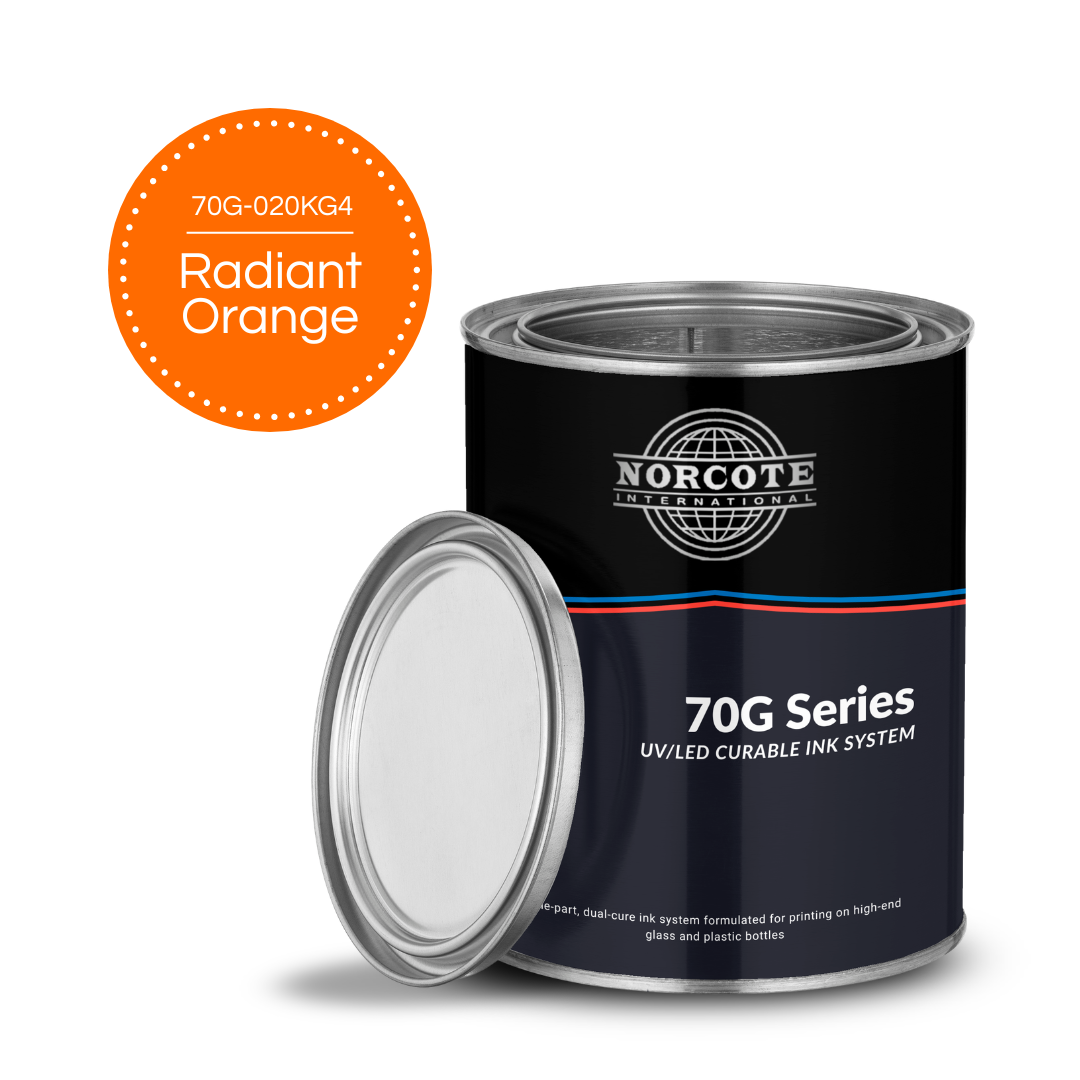
Norcote 70G UV/LED Ink for Glass & Plastic Containers - 1 Gallon Pail
Norcote 70G UV/LED Ink for Glass & Plastic Containers - 1 Gallon Pail
SKU:645456
No se pudo cargar la disponibilidad de retiro
The Norcote 70G Series is a one-part dual-cure screen printing ink system developed for demanding decoration of glass and plastic containers. Designed for the container market, it combines strong adhesion potential, high durability, clean print definition, and broad curing flexibility for premium bottle and packaging applications.
What makes the 70G Series stand out is its ability to cure under both traditional UV systems and LED systems with peak wavelengths between 365 and 405 nm. Its highly thixotropic rheology helps maintain controlled flow, stable print performance, and strong visual coverage, while post-cure cross-linking continues to build film performance after printing.
Features & Benefits
- Dual Cure Capability: Compatible with UV mercury, iron-doped, and LED curing systems.
- Built for Container Printing: Developed for high-end glass and plastic bottle decoration.
- Excellent Adhesion Potential: Suitable for glass, HDPE, polypropylene, PET, LDPE, and additional compatible substrates when properly prepared.
- High Durability: Designed for strong resistance to scuffing, marking, and demanding handling conditions.
- Production-Ready Formula: Intended for use directly from the container in most applications.
- Specialized Whites, Blacks, and Bases: Supports opacity, durability, metallic effects, and controlled translucency.
- Post-Cure Performance Development: Continues cross-linking after curing for improved final film properties.
- Custom Color Flexibility: Supports color matching and tailored ink development.
Also Known As:
Also Known As:


Guidelines and Specifications for Norcote 70G Series
How to Choose the Right 70G Ink
Ink selection should be based on substrate, opacity requirements, durability needs, and curing method. For maximum coverage on clear or light-colored containers, high-opacity whites such as 70G-1056 Opaque Bright White are often preferred. For longer production runs where shear can reduce body, 70G-1068HV High Viscosity Opaque White helps maintain print consistency.
Where scratch, mar, and surface durability are critical, 70G-1046 SR White offers enhanced resistance. For dark graphics, 70G-4000 Jet Black provides a deep, rich black for natural and semi-opaque bottles, while 70G-1019 Opaque Black is better suited to darker substrates and color matching work. For metallics and special effects, 70G-000 Metallic Mixing Base is the correct starting point, while 70G-049 Standard Mixing Base and 70G-049LED LED Mixing Clear are intended for translucency and color matching.
Applications & Substrate Compatibility
The 70G Series is primarily intended for printing on glass, HDPE, and polypropylene containers. For glass, Norcote strongly recommends flame pretreatment immediately before printing to achieve optimum adhesion, chemical resistance, and water resistance. For cold-end coated glass, pretreatment is especially important, and the use of Pyrosil® or Uvitro® is recommended.
For HDPE and polypropylene, surface energy above 42 dynes is strongly recommended, typically achieved through flame treatment. The series has also shown adhesion on PET bottles, LDPE bottles, corrugated polyolefins, flat HDPE sheet, and coated or uncoated metals, though end-use testing is recommended before production.
Core 70G Ink Colors & Bases
Standard Colors
- 70G-012KG4 – Radiant Yellow: High-brightness yellow for vivid graphics and strong visual impact.
- 70G-016KG4 – Brilliant Yellow: Clean yellow shade suited for bright graphics and color matching applications.
- 70G-2233KG4 – Opaque Yellow: High-opacity yellow designed for strong coverage on darker or tinted substrates (limited lightfastness; not recommended for extended UV exposure)
- 70G-019KG4 – Permanent Orange: Strong orange shade developed for bold, durable color reproduction.
- 70G-020KG4 – Radiant Orange: Bright orange tone intended for highly visible graphic work.
- 70G-021KG4 – Cha Cha Red: Vivid red for strong packaging graphics and bright design work.
- 70G-022KG4 – Red: Standard red shade for general-purpose printing and color development.
- 70G-023KG4 – Rhodamine Red: High-intensity red/magenta shade for vivid color applications.
- 70G-024KG4 – Rose: Bright pink tone with high visual impact, ideal for cosmetic and specialty packaging applications (not recommended for prolonged outdoor exposure)
- 70G-030KG4 – Emerald Green: Rich green shade for strong, saturated color reproduction.
- 70G-031KG4 – Spruce Green: Darker green tone for deeper graphic applications.
- 70G-034KG4 – Permanent Blue: Stable blue shade designed for durable color performance.
- 70G-035KG4 – Violet: Strong violet tone for specialty and branding applications.
- 70G-037KG4 – Reflex Blue: Deep, high-strength blue for bold graphics and color-intensive applications.
- 70G-2313KG4 – Lightfast Yellow: Yellow option intended where improved light stability is required.
- 70G-2872KG4 – Lightfast Orange: Orange option intended where improved light stability is required.
Whites
- 70G-311KG6 – Opaque CMG White: Non-tinted white with increased photoinitiator loading to assist difficult color matching and curing.
- 70G-1054KG6 – Opaque White: Reduced-opacity white suited for use across a wider range of mesh counts.
- 70G-1056KG6 – Opaque Bright White: Very opaque blue-shade white intended for high mesh count printing and maximum visual coverage.
- 70G-1046KG6 – SR White: Specialty white designed for superior surface durability, scratch resistance, and mar resistance.
- 70G-1068HVKG6 – High Viscosity Opaque White: High-viscosity white developed for long production runs where ink shear may reduce body over time.
Blacks
- 70G-1019KG4 – Opaque Black: Formulated for dark-colored bottles and color-matching applications.
- 70G-4000KG4 – Jet Black: Deep, rich black formulated for strong contrast and high visual density on natural and semi-opaque bottles.
Clears & Bases
- 70G-000KG4 – Metallic Mixing Base: Clear base with increased photoinitiator loading intended for metallic, fluorescent, and special effect pigment systems.
- 70G-049KG4 – Standard Mixing Base: General-purpose clear for color matching and applications where translucency is required.
- 70G-049LEDKG4 – LED Mixing Clear: Clear is designed for color matching and translucent ink systems where LED cure compatibility is required.
Custom Color Matching
The Norcote 70G Series supports custom color matching for brand-critical packaging applications. Specific colors can be matched using customer-supplied printed samples, wet ink references, or Pantone® color standards.
This gives printers and brand owners a practical route to exact color development without moving outside the 70G system.
Printing & Processing Guidelines
Surface Preparation
Proper surface treatment is critical to adhesion. For glass, flame pretreatment immediately before printing is strongly recommended. For HDPE and polypropylene, a surface energy level above 42 dynes is strongly recommended and is typically achieved with flame treatment.
Ink Handling
All inks should be mixed thoroughly before use and remixed during production if they stand in a covered container for more than three hours. The 70G Series is formulated for direct use from the container, though viscosity may be adjusted with 70G-070 Thinner at up to 10% by weight when necessary. Because the system is highly thixotropic, the press should be allowed to stabilize before adding thinner or other additives.
Mesh Selection
Low-elongation plain weave polyester mesh of 305 threads per inch and above is recommended. For 70G-1056 Opaque Bright White and 70G-4000 Jet Black, mesh counts between 380.33PW and 460.27PW are specifically recommended to maintain opacity and density.
Curing Considerations
Typical UV curing parameters call for a 400 wpi mercury or iron-doped lamp with an average minimum output of 300 mJ/cm² and approximately 800 mW/cm². For LED curing, 8–20 w/cm systems with peak output between 365 and 405 nm are recommended. Full cure depends on film thickness, opacity, substrate color, and lamp output, so cure testing should be performed before and during production. LED-cured inks are also highly sensitive to ambient light exposure.
Adhesion, Resistance & Performance Notes
The 70G Series is a non-visual post-curing system, and cross-linking can continue for up to 24 hours after printing. The cooled ink film should pass a basic cross-hatch or tape adhesion test after exiting the cure unit and cooling to room temperature. If water resistance is required, end-use testing is recommended before production.
The series is also formulated for improved marking and scuff resistance. For difficult substrates, selected additives may be used to improve adhesion, though they reduce pot life and should only be added to the amount of ink that will be used within the working window.
Common Mistakes When Using UV Inks
The most common performance issues usually come from insufficient surface treatment, premature viscosity adjustment, poor mesh selection for high-opacity inks, and incomplete cure validation on darker or tinted substrates. Excessive ambient light exposure can also affect LED-curable systems, so containers should remain covered when not in use.
Technical Specifications
- Product Type: UV / LED dual-cure screen printing ink
- System Type: One-part ink system
- Primary Use: High-end glass and plastic bottle printing
- Cure Compatibility: UV mercury, iron-doped, and LED systems
- Recommended LED Peak Wavelength: 365–405 nm
- Recommended UV Output: 400 wpi lamp, 300 mJ/cm² minimum, approximately 800 mW/cm²
- Ink Rheology: Highly thixotropic
- Recommended Mesh: 305 threads per inch and above
- Special Mesh Range for 70G-1056 and 70G-4000: 380.33PW–460.27PW
- Recommended Surface Energy for HDPE and PP: Above 42 dynes
- Optional Thinner: 70G-070, up to 10% by weight
- Post-Cure Cross-Linking: Continues up to 24 hours after printing
- Compatible Substrates: Glass, HDPE, polypropylene, PET, LDPE, corrugated polyolefins, coated and uncoated metals
- Water Resistance Verification: Cross-hatch/tape test recommended after cure and cooling
- Packaging Note: Series is sold by weight rather than volume
Important Notes
Because substrate characteristics, molding conditions, treatment levels, pigments, and curing environments can vary significantly, full adhesion, cure, and end-use testing should always be performed before production. Do not microwave this product. For best results, verify substrate readiness, cure response, and finished film durability under actual production conditions.
If you have any questions or are unsure about anything, feel free to reach out at sales@cureuv.com or call us at (561) 243-8442.